


The A To Z Of Mr. Bungle's Debut Album

Updated: Aug 14
Some albums demand your attention. Others grab you by the throat, empty a bucket of circus sludge over your head and laugh as your brain melts out of your ears. Thirty-five years ago, Mr. Bungle unleashed their self-titled debut. Equal parts metal, funk, ska, jazz, carnival nightmare and full-blown musical psychosis, it was an album that shouldn’t have worked, but somehow became one of the most influential cult records ever released on a major label. Loved, loathed and still utterly impossible to categorise, Mr. Bungle remains a beautiful freak of nature. Three-and-a-half decades later, we’re diving headfirst back into the madness to celebrate the album that proved there was genius lurking inside complete and utter chaos.

A is for My Ass Is On Fire
For a band that treats its own catalogue like a playground, My Ass Is On Fire has proved remarkably untouchable. The seventh track from the record remains the only song to survive every chapter of the band's live history.
Across more than three decades, the song has been torn apart, rebuilt, stretched, twisted and reimagined to fit whatever version of Mr. Bungle happened to be standing onstage. From the feverish funk-metal chaos of the early '90s to the genre-defying experiments of the Disco Volante and California years, and even into the band's thrash-fuelled reunion era, My Ass Is On Fire has continued to mutate.
A low-budget video for My Ass Is on Fire was also put together by Steve Lederman, and several raw 1991 live performances document the band's unhinged early era.
B is for Bubble Bath
At selected retailers, fans who picked up the album were handed a miniature bottle of Mr. Bungle Bubble Bath - a weird and wonderfully pointless promotional freebie that perfectly captured the group’s off-the-wall sense of humour. A collectible and conversation piece, it was exactly the kind of surreal marketing stunt you’d expect from Mr. Bungle.
C is for Cotton Candy Autopsy
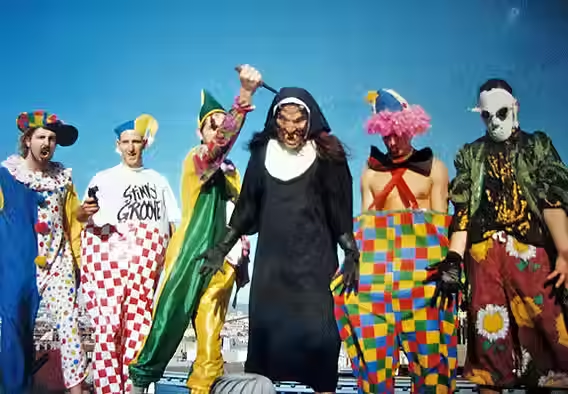
The album’s twisted cover artwork, along with several images scattered throughout the liner notes, were lifted from Issue 1 and Issue 13 of the cult comic series Beautiful Stories for Ugly Children, illustrated by Dan Sweetman. Dark, grotesque and dripping with warped humour, the artwork perfectly mirrored the band’s disturbing and unpredictable sounds hidden inside.
'The Sweetman stuff was not really a collaboration. We were aware of his work and reached out to him for permission to use the images which he allowed to be colored and chopped up. We had previously asked Joel-Peter Witkin for use of some images….if I recall correctly one of a circus freakshow guy hammering a nail into his own nose and another of two bodiless heads kissing. We were denied usage. I also remember wanting to use the black and white clown (on the disc itself) to be used for the cover but I was out-voted by the other members. So be it. Another tidbit: We had asked the designers to make the sky red, not blue, to represent the fire the clown had lit, but “artistic freedom” prevented us from having our way.' - Trevor 2016
D is for Dead Goon
A twisted tale of fatal autoerotic asphyxiation, the song is classic Mr. Bungle: dark, absurd and technically breathtaking. Trevor Dunn’s dizzying chromatic bass line has become legendary, although actually written by Danny Heifetz, while the band ricochet between warped carnival music, crushing metal, funk and jazz, punctuated by choking, gargling and the sinister creak of a tightening rope.
'One of those places was "The Chicken Coops" out in Manila which is a frightening little "beach town" of white-trash hillbillies. My dad used to work at a lumber mill out there. The place was literally an old, abandoned chicken coop with ceilings about 5 1/2 feet high. It was rented by a weird family who used to send their half-wit, stuttering son out to collect the "went money" from us. The song Dead Goon was conceived, almost in its entirety, from a free-form jam session one cold, damp night in those coops.' - Trevor
E is for Eureka
The band’s hometown roots remained firmly intact. While recording the album, Trevor was still living at his mum’s house in Eureka – a reminder that, for all Mr. Bungle’s growing notoriety, they were still just a bunch of small-town misfits on the verge of something far bigger.
'We'd go down to the railroad, hop the freight train to the next town, and then hitchhike home," Dunn recalls fondly. "We were kind of obsessed with it, actually. It was super fun on a summer night. We'd write songs based on the rhythms of the tracks—Mr. Bungle had a song called 'Freight Train' In fact, the first Mr. Bungle album has a 10 minute sequence of us on the freight train that I taped on my little handheld tape recorder.' - Trevor 2013
'You have, essentially, homeless, violent clowns that are breaking bottles over each other’s head, kind of stuff, so we found a guy who was sleeping on the ground in the middle of the night, and we just recorded him snoring. And then we walked down the street a little ways, and busted a window! [Laughing] I’m not real proud of these things, but that’s what we did. We were kind of living the ultraviolence. We didn’t kick the bum’s head in like Clockwork Orange or anything, but we did wake him up with a broken window about ten feet away from him, and that’s the beginning of the record.' - Trey 2016
F is for Face-masks
Long before Slipknot turned masks into metal’s most terrifying trademark, Mr. Bungle were already disappearing behind rubber disguises. As their music spiralled further into glorious insanity, so did the masks. One night it was Pinhead. The next, a Native American, Madonna, or a leather-clad gimp.

G is for Glaucoma
Reflections of a bloated lie
A life stored in your cloudy eye
Now it's time to say goodbye
Stubb a dub will never die
Forget rock mythology – Stubb (A Dub) is inspired by something far more personal: guitarist Trey Spruance’s childhood dog. But in true Mr. Bungle fashion, what could’ve been a sentimental tribute is twisted into something equal parts heartbreaking, hilarious and deeply unsettling. According to bassist Trevor Dunn’s live introductions and long-standing Bungle folklore, the song chronicles Stubb’s final days as old age took its toll. Spruance later revealed that before joining his family, the dog had suffered horrific abuse, abandoned at the side of a road by a previous owner after having her tail cruelly cut off.
Rather than telling the story straight, Mr. Bungle dive headfirst into madness. Mike Patton’s warped, experimental vocal performance is designed to sound like the fractured inner monologue of a senile dog, transforming a surprisingly touching farewell into one of the band’s strangest, most emotionally warped moments.
H is for Dennis Hopper
The band’s debut is packed with samples, but none more infamous than Dennis Hopper’s deranged Frank Booth from David Lynch’s 1986 cult classic Blue Velvet.
I is for Influence
Mr. Bungle’s unhinged debut didn’t just melt minds – it rewired heavy music’s DNA. Fusing metal, funk, ska, jazz, pop, carnival insanity and avant-garde experimentation into one delirious package, the album became a landmark for musicians who refused to be boxed in. Its influence echoed through an entire generation, with members of Incubus, Korn, Avenged Sevenfold and Slipknot all pointing to its fearless genre-smashing madness as a major inspiration.

‘Another one of our inspirations were a band called Mr. Bungle... They went up on the stage and they just went... put their masks on and they stood there for like ten minutes just like... Crowds start booing them, you know, and they wouldn't... nothing. They didn't even give a rip. They were so weird. And so we got heavily inspired by them.’ - Brian "Head" Welch
J is for Jennifer and Kahli
Two of the backing singers listed in the liner notes were dragged in off the street!
'I don't remember Jennifer by name, but yes, both girls who did that talking bit were strippers - we had them talk about Bär because in our minds he was the most qualified for them to focus their attention on did that make it onto the record? I don't remember, but I remember them saying "oh Bär, look at those muscles”’ - Trey 2026

K is for KFC
One of the albums cheekiest samples appears in Slowly Growing Deaf, where Mr. Bungle sneak in an unauthorised outtake of Colonel Harland Sanders flubbing his lines during a KFC commercial. As the fast-food icon struggles with the phrase “most folks,” the band turn the blooper into another layer of their surreal sonic collage. Sanders also gets a lyrical nod in Squeeze Me Macaroni, namechecked alongside a barrage of food brands - because in Mr. Bungle’s warped world, even the Colonel isn’t safe.
'Did Colonel Sanders really have to demean himself to the point of crapping to two-inch? That must have been the low point of his career, post-KFC.' - Danny 2016
L is for Lunchroom Manners
Long before Mike Patton and company turned the name into a cult phenomenon, Mr. Bungle was an ill-mannered puppet created for a 1959 educational film teaching American schoolchildren how not to behave in the cafeteria. The scruffy troublemaker became an unlikely cult icon after resurfacing on Pee-wee Herman‘s TV show in 1981, and it wasn’t lost on this gang of misfit teenagers. Naming their band after the gloriously obnoxious puppet, they completed the circle by weaving audio snippets from the original film into their self-titled debut.
M is for Maximum Bob
Maximum Bob is credited for backing vocals to the album. The connection carried over to the stage, too, with Bob’s band The Deli Creeps (featuring Bucket head) supporting Mr. Bungle throughout their 1991 tour.
'We were also friends with a band called The Deli Creeps whose guitar player went by the name of Buckethead. The singer, Maximum Bob, was a big guy who used to light his farts with matches. You can hear him chanting "over and over" at the end of My Ass Is On Fire. So, yeah, there were some weirdos hanging around.' - Trevor
N is for Nintendo
Mr. Bungle’s pop culture obsession extended beyond film and TV, with their self-titled debut packed with arcade and console samples, including Sega’s Altered Beast, Namco’s Scoreboard and Nintendo’s Super Mario Bros. It didn’t stop in the studio either - throughout 1991, the band regularly broke into a warped Super Mario Bros. medley live.

O is for OU818
OU818 marked the end of Mr. Bungle’s demo era and the start of the band’s classic line-up. Self-released on cassette on June 28, 1989, its title spoofed Van Halen’s OU812, showcasing the band’s early warped humour.
Recorded and mixed in three days at Dancing Dog Recording Studio in Emeryville with producer David Bryson, it introduced Danny Heifetz and Clinton “Bär” McKinnon. Four tracks - Squeeze Me Macaroni, Slowly Growing Deaf, The Girls of Porn and Love Is a Fist - were later reworked for their debut album.
P is for Platypus and other B-sides
Alongside Mr Nice Guy and a gloriously twisted cover of Thunderball, Mr. Bungle also cut an early version of Platypus. It didn’t make the final tracklist, though, instead mutating into the version that finally surfaced on Disco Volante.
Q is for Quote Unquote
Before it became Quote Unquote, the album’s disturbing opening track was simply titled Travolta. But with fears of a legal clash over John Travolta’s ties to Scientology, Warner Bros. pushed the band into a last-minute name change. Around 20,000 album sleeves had already been printed before the switch, instantly creating one of the most sought-after early pressings in the band’s catalogue. Oddly enough in 1996 there was a John Travolta biography released as part of the Quote Unquote series.
As if that wasn’t controversial enough, the song’s Kevin Kerslake-directed video was swiftly blacklisted by MTV. Featuring the band dangling from meat hooks in a grotesque carnival of surreal imagery, it was deemed too extreme for daytime television.
'Looking back… we very much identified with this tragically monstrous character, who in his extreme sensory isolation was effectively living outside of time and space.' - Trey 2016
R is for Raw Footage
Leave it to Bill Gould to uncover one of Mr. Bungle’s strangest pop culture connections. It was the Faith No More bassist who alerted the band to the existence of Raw Footage, a gloriously sleazy 1977 adult film featuring a character named Mr. Bungle. Never ones to waste an obscure reference, the band lifted a snippet of dialogue from the movie and dropped it in just before Girls of Porn.
S is for Sharkey’s Arcade
Sharkey's was a popular hangout and arcade spot in Eureka, CA, during the 1980s when the band members were growing up.
Trey walked around the arcade with a portable digital audio tape (DAT) recorder to capture ambient sounds, bleeps, and effects straight from pinball machines, some of which can be heard on song like Stubb a Dubb.
T is for ... A Tractor in my balls again?
Before Mr. Bungle had even released an album, Mike Patton was already running a marketing masterstroke. Whether onstage with Faith No More, in videos or on TV, he was rarely seen without a Mr. Bungle T-shirt. Soon, eagle-eyed FNM fans were all asking the same thing: “Why’s he got a tractor in his balls… again?” Confused, curious and impossible to ignore – exactly the reaction Patton wanted.

U is for Uremia
Uremia is a highly coveted, unofficial live bootleg 7-inch vinyl pressed in Italy in 1992. It was highly limited, with only 500 copies ever produced. The vinyl contains soundboard recordings from Mr. Bungle's concert at The Vic Theatre in Chicago on March 26, 1992, while they were touring their self-titled album. Also known as Mi Stroke Il Cigaretto the vinyl was eventually sold at the merch stall by the band on tour.
V is for Vlad Drac
Fresh from joining Faith No More, Patton was determined not to let Mr. Bungle be dismissed as simply his “other band.” Keen to avoid trading on his newfound fame, he was credited on the album as Vlad Drac – a suitably sinister alias that perfectly matched the bloodsucking vampire mask he stalked the stage in during the band’s early live shows.

W is for Warner bros
That wasn’t quite the game plan at Warner Bros. While Patton was doing everything he could to keep Faith No More and Mr. Bungle as separate entities, the label saw a golden marketing opportunity. Promotional ads shamelessly branded the album as “Mike Patton’s Other Band”, complete with the tongue-in-cheek slogan: “Why can’t a person be in two bands?” It was a clever sales pitch - but one that flew in the face of Patton’s determination to let Mr. Bungle stand on its own beautifully bizarre merits.
'Just the situation of being in two bands is cause for rumours. Being in two bands gives someone ammunition to write total bullshit about me. It's something for the press to pick up on, especially considering that was the case with Chuck, except we don't have fist-fights like they did. This is something else for the press; 'Oh, the singer's got another band, he's not completely loyal, he's cheating, he's committing adultery, the sonofabitch, brat, pig!' - Patton 1990
X is for Existential Blues and other covers
Existential Blues is a gloriously bonkers 1979 novelty song by Tom “T-Bone” Stankus, mashing The Wizard of Oz‘s poppy field nightmare with an existential meltdown. Naturally, it was right up Mr. Bungle’s street.
Touring their 1991 debut, Mr. Bungle turned every show into a musical car crash in the best possible way, peppering their sets with wildly unpredictable covers woven between their own songs. Bond themes, punk, jazz, film scores, TV tunes and video game music all collided in glorious chaos.
The setlist regularly veered through Thunderball, Billy Squier’s The Stroke, Dead Kennedys’ Drug Me, Charlie Parker’s Yardbird Suite, Ennio Morricone’s Città violenta, and A Taste of Honey, popularised by Bobby Scott and Herb Alpert. With Mr. Bungle, absolutely nothing was sacred.
Y is for Yeesus Krist
Yeesus Krist aka Kristen Yee Mr. Bungle's manager in 1991 is credited for backing vocals also. Check out this interview from The Vinyl Guide.
Z is for John Zorn
Mr. Bungle didn’t just want a producer – they wanted a fellow musical anarchist. Enter John Zorn, whose late-‘80s sonic assaults Naked City, Spillane and Spy vs. Spy had already blown the band’s minds. Despite being signed to Warner Bros., Bungle had no interest in playing it safe, dragging Zorn in to steer the album even further into glorious chaos.
He also unleashes a ferocious alto sax freak-out on Love Is A Fist. Better still, the sessions ignited a decades-long creative partnership, with Patton and Dunn becoming frequent Zorn collaborators.
'When he produced 'Mr Bungle', it was a really comfortable fit and we've been friends ever since. He was certainly one of the main people who have made a huge impact on my musical life, without a doubt. He put me in many compromising positions and held my hand, so to speak. That's the only way you can learn.' - Patton 2013


Comments